I make at least one trip to Ranthambhore Tiger Reserve every year.
Preferably in the high summer month of June. This year however, I had to
do it in May due to some commitments in June. This year's trip was a
mixed bag. For a start, things in Ranthambhore are deteriorating by the
day. I've been going to the Park for over eight years in a row now.
Sadly, every trip is worse than the previous. Here I shall present some
intersting images from the trip and also try to give some information
that future visitors might find useful.
My original plan was to spend three days in June looking up the tigers at Ranthambhore Tiger Reserve (RTR) as usual. However, when my dear friend and fellow birder and renowned photographer Nikhil Devasar suggested we do a longer trip and try to get as many tigers as possible and this time in May, I readily agreed as some appointments had come up for June and it would have been difficult to squeeze in a trip to RTR. So May it was. Surprisingly, getting reservations on trains to and from Sawai Madhopur turned out to be easy. 13th Ex Nizamuddin by Kota SF Special starting at 5:20 am and returning from Sawai Madhopur on 18th by August Kranti Rajdhani. The timings suited us. on 13th we could do the afternoon safari and two safaris per day on 14, 15, 16 and one on 17th (total 8 safaris).
I usually stay at the Spartan Rajasthan Police Mess, euphemistically called "Anveshan Bhawan"or Interrogation Centre mainly to save money (Rs. 500 a day room + three meals).
The trip on 13th afternoon was not only a total washout, but also tiring as the full heat of Rajasthan summer hits one fresh from the Air Conditioned comforts of the Mess!
Normally on a tiger safari, one is totally focused (pun intended) on tigers only. More than you it is the guide who feels the need to show you one every single trip. You may live with not sighting a tiger, but the driver and the guide would be terribly upset. To make matters worse, every time you have a new set of drivers and guides, who feel compelled to drive at breakneck speed and impress you, if not with a tiger sighting, at least with their efforts to show you one. On 13th the only photographs I could manage were a few shots of odd Peacocks, Sambhar Deers, an odd Osprey, who have managed to stay back and the friendly Treepie.


Next day I was lucky to have a Police vehicle which was Zonefree, meaning there was no restriction where you can go. The driver, Nawal Kishore is an expert guide also. Armed with these strong points in our favour, we fearlessly went to Zone 3 where the previous night good sightings were made. Unfortunately, no sighting of even a decent bird to shoot. However, learning that the aged Queen of RTR, Machhli was seen near a kill, we hurried to Panduka to catch a few seconds of fleeting look at her. No photos. Returned without even taking one shot!. 14th was Chouth following Akshaya Thritiya and the steady stream of pilgrims using the parikrama around the fort seem to have disturbed wildlife! But luck shined on us the next session.
As we entered the Park, the Forest Guard quietly indicated to our driver Nawal that he should hurry to Jogi Mahal. From a distance itself we say two gypsies with huge Canon Video Cameras fitted filming something across the small water body. There lazing by the water was the graceful female tiger T19, sister of T17 ( More about T 17 later) and daughter of the famous Macchli. We parked ourselves in a vantage spot and then I started cursing myself. Damn! I did not put my 500mm lens and D300 with the cropped Censor which would have made it 750mm and my beanbag which I had filled with rice behind in my room! Lost a chance to take some awesome images.


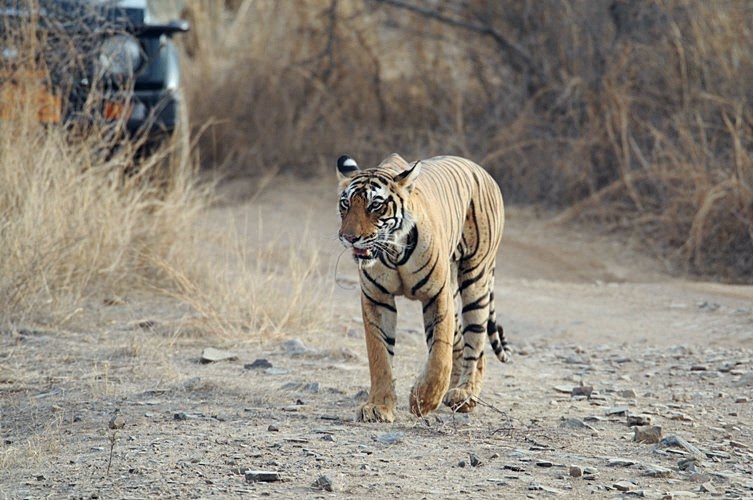
By now a few more teams of not-so-serious tourists had arrived and the noise levels had started going up, disturbing T19. The tiger soon got up and left triggering off a furious rush by a large number of Gypsies chasing . We were slow in reacting or catching up. Our slow start turned out to be a blessing in disguise. T19 was a bit overwhelmed by the long stream of cars and she entered the Chhatri by the roadside near the gate. The caravan rushed past and she emerged into the road a few yards from us, looking us in the eye. We backed off and she kept walking towards us. What an awesome sight! I shot most of the images at 80mm to 100mm only. Still managing to fill the frame! By then the chasers turned around and another mad rush and two newcomers behind us. The poor tiger had no option but to beat a hasty retreat!


I have a special attachment to T17. Though I had seen T16 Machhli and a few male tigers from Ranthambhore earlier, it was T17 who posed for me and gave me good photographs first. I had been following her activities and saw her in Jogi Mahal closer than I now saw T19. The forest Staff who were suspecting her to be pregnant also were at Jogi Mahal and they had borrowed my binoculars to ascertain that she is indeed pregnant. After Machhli became old, T17 had become the most prominent female tiger of the Raj Bagh Lake and nearby area. She was graceful and bold. There was a time when she passed so close that my friend Anand Arya could not take a shot because it was closer than the minimum focus distance! Nalla Muthu’s Tiger Dynasty celebrates, among others, the majesty of T 17.
I had been informed that T17 was badly injured in a fight with a male tiger T 28 over a kill in late December2012. At that time authorities should have tranquillized her and treated her. Also, her radio collar had stopped working and it needed replacement. Neither of which was done by the Wildlife Authorities. Then about 9 weeks ago sighting of T17 ceased. Searches if any were perfunctory and till date officially no one knows what happened to her. Two theories are popular among wildlifers. One is, and the official view tends to toe this line, she succumbed to her injuries in some unknown secret cave or hide and soon the body decayed or was eaten by scavengers. The other is that being injured, she could not hunt naturally and she took to preying on domestic cattle and the villagers killed her and buried her. The names of certain village and some prominent persons are going the round in this regard. A third, less popular theory is that she fell victim to poachers. She was injured and in any case she had always been bold and confiding by nature. Whatever the truth, Wildlife Authorities and Park Administration cannot absolve themselves of the responsibility of the tragic loss. Read it against the background of the loss in March of another equally magnificent female tiger T37. My salute to T17!


Gyan on RTR and Tiger-shooting
Tigers are much easier to spot and photograph during the peak summer, closer to the Park closing dates, the better. The flip side is, be prepared to face 48 degree sun in an open Gypsy.
Summer heat can be made less harsh by taking a few precautions.
1. Take a gamcha or thin towel preferably not white. In fact buy several before you leave. The more earthy the colour the better. Wrap it around your face and neck to protect from harsh sunlight. Another advantage of wrapping your face including the nose is that the moisture from your breath saves your lips and skin getting dry and parched.
2. Use long sleeved shirt made of thin material. Short sleeved T shirts, etc exposes your hands which get sun burnt and dry. You lose more water also.
3. Make sure you have a wide-brimmed hat with a chin strap.
4. Use the highest SPF sun block on exposed parts.
5. Drink a lot of water. Before, during and after the trip.
6. Get hold of an ice box. Carry from home, beg, borrow steal or snatch. This one item is going to make all the difference in a Summer safari in RTR!
7. The best drink out there on a safari is lemonade with sugar and salt. If your resort doesn’t provide, buy lemons from the market and make it yourself. Carry with you.
8. Carry ORS with you. Several packets. Especially if your children are also braving the safaris.
9. Go easy on alcohol in the evenings. It dehydrates you.
10. Eat a lot of salads, especially Khira, Kakri and raw onions. Green Chilies are also good to prevent heat stroke.
11. Keep one gamcha wet and put it in the fridge before you leave for safari. The pleasure of wiping your face and head with the cold towel on return in incomparable!
12. There is no need to wear a hiking boots or costly footwear on a safari. You are not allowed to get out. Even a sandal would do if you are comfortable with it. I take a light sports shoe with terry towel socks.
Most drivers and guides feel bad if they are not able to show you a tiger. No need to push them further. It frustrates them. I had a very bad companion once who after the first unsuccessful safari harassed the driver and guise so much, they got paranoid and drove like mad people from one place to another. The most tiring safari in my life.
Please tell the guide and driver in advance if you are a serious photographer. They are mostly used to people who just want to have a look at a tiger. If they know you are serious, then they will go the extra mile to get you a good angle and vantage point.
Switch off the AC at least an hour before starting on Safari in May
Tigers do not know the Zone demarcation. So they are likely to wander into Zones where they are not supposed to be.
Chocolates melt and mess up your pocket. Skip them! Keep some energy bars or similar QRF (Quick Refreshing Food) with you on safari.
Having two wonderful sighting of tigers, we wanted a variety. We were told that 60 KM from Sawai Madhopur, there is a place where one can see the dens of Wolves. Recently someone had also posted the image of a female with juvenile from that area. The only place in the plains of India where I has spotted Wolf was in the Little Rann of Kutch two years ago. The sighting of the Indian Wolf near Banas River was too good a news to resist a quick trip. We had tied up with a friend who claims to know the place well and even spoken to the local contact. We were to start at 2 AM and reach the place before dawn for the sighting. Man proposes, God disposes! As it turned out, the friend did not turn up and even refused to pick up his cell phone either. The plan had to be abandoned giving us a much needed free, lazy morning.
One more safari left! Hope it is as good as the last!
In fact, it turned out to be better. We got permission to tag along with some professionals and enter restricted Zones! What more can one ask for!
We had the great pleasure of sighting three Sub-adult Tigers, all offspring of Female Tiger T30 and Male Dominant Tiger T3 whom we had spotted yesterday at the waterhole!


And now a few more images from the trip. Professionals at work.

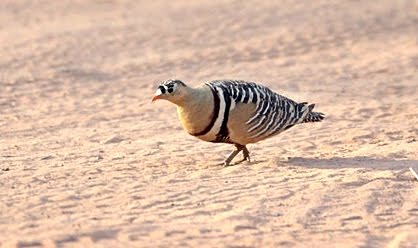
Painted Sandgrouse Female

Thank God for a wonderful trip.

My original plan was to spend three days in June looking up the tigers at Ranthambhore Tiger Reserve (RTR) as usual. However, when my dear friend and fellow birder and renowned photographer Nikhil Devasar suggested we do a longer trip and try to get as many tigers as possible and this time in May, I readily agreed as some appointments had come up for June and it would have been difficult to squeeze in a trip to RTR. So May it was. Surprisingly, getting reservations on trains to and from Sawai Madhopur turned out to be easy. 13th Ex Nizamuddin by Kota SF Special starting at 5:20 am and returning from Sawai Madhopur on 18th by August Kranti Rajdhani. The timings suited us. on 13th we could do the afternoon safari and two safaris per day on 14, 15, 16 and one on 17th (total 8 safaris).
I usually stay at the Spartan Rajasthan Police Mess, euphemistically called "Anveshan Bhawan"or Interrogation Centre mainly to save money (Rs. 500 a day room + three meals).
The trip on 13th afternoon was not only a total washout, but also tiring as the full heat of Rajasthan summer hits one fresh from the Air Conditioned comforts of the Mess!
Normally on a tiger safari, one is totally focused (pun intended) on tigers only. More than you it is the guide who feels the need to show you one every single trip. You may live with not sighting a tiger, but the driver and the guide would be terribly upset. To make matters worse, every time you have a new set of drivers and guides, who feel compelled to drive at breakneck speed and impress you, if not with a tiger sighting, at least with their efforts to show you one. On 13th the only photographs I could manage were a few shots of odd Peacocks, Sambhar Deers, an odd Osprey, who have managed to stay back and the friendly Treepie.


Next day I was lucky to have a Police vehicle which was Zonefree, meaning there was no restriction where you can go. The driver, Nawal Kishore is an expert guide also. Armed with these strong points in our favour, we fearlessly went to Zone 3 where the previous night good sightings were made. Unfortunately, no sighting of even a decent bird to shoot. However, learning that the aged Queen of RTR, Machhli was seen near a kill, we hurried to Panduka to catch a few seconds of fleeting look at her. No photos. Returned without even taking one shot!. 14th was Chouth following Akshaya Thritiya and the steady stream of pilgrims using the parikrama around the fort seem to have disturbed wildlife! But luck shined on us the next session.
As we entered the Park, the Forest Guard quietly indicated to our driver Nawal that he should hurry to Jogi Mahal. From a distance itself we say two gypsies with huge Canon Video Cameras fitted filming something across the small water body. There lazing by the water was the graceful female tiger T19, sister of T17 ( More about T 17 later) and daughter of the famous Macchli. We parked ourselves in a vantage spot and then I started cursing myself. Damn! I did not put my 500mm lens and D300 with the cropped Censor which would have made it 750mm and my beanbag which I had filled with rice behind in my room! Lost a chance to take some awesome images.


By now a few more teams of not-so-serious tourists had arrived and the noise levels had started going up, disturbing T19. The tiger soon got up and left triggering off a furious rush by a large number of Gypsies chasing . We were slow in reacting or catching up. Our slow start turned out to be a blessing in disguise. T19 was a bit overwhelmed by the long stream of cars and she entered the Chhatri by the roadside near the gate. The caravan rushed past and she emerged into the road a few yards from us, looking us in the eye. We backed off and she kept walking towards us. What an awesome sight! I shot most of the images at 80mm to 100mm only. Still managing to fill the frame! By then the chasers turned around and another mad rush and two newcomers behind us. The poor tiger had no option but to beat a hasty retreat!


Two safaris on 15th drew a blank. The only time when I took out the camera on 15th was to click this pair of Indian Scops Owls.


The T 17 Story
I have a special attachment to T17. Though I had seen T16 Machhli and a few male tigers from Ranthambhore earlier, it was T17 who posed for me and gave me good photographs first. I had been following her activities and saw her in Jogi Mahal closer than I now saw T19. The forest Staff who were suspecting her to be pregnant also were at Jogi Mahal and they had borrowed my binoculars to ascertain that she is indeed pregnant. After Machhli became old, T17 had become the most prominent female tiger of the Raj Bagh Lake and nearby area. She was graceful and bold. There was a time when she passed so close that my friend Anand Arya could not take a shot because it was closer than the minimum focus distance! Nalla Muthu’s Tiger Dynasty celebrates, among others, the majesty of T 17.
I had been informed that T17 was badly injured in a fight with a male tiger T 28 over a kill in late December2012. At that time authorities should have tranquillized her and treated her. Also, her radio collar had stopped working and it needed replacement. Neither of which was done by the Wildlife Authorities. Then about 9 weeks ago sighting of T17 ceased. Searches if any were perfunctory and till date officially no one knows what happened to her. Two theories are popular among wildlifers. One is, and the official view tends to toe this line, she succumbed to her injuries in some unknown secret cave or hide and soon the body decayed or was eaten by scavengers. The other is that being injured, she could not hunt naturally and she took to preying on domestic cattle and the villagers killed her and buried her. The names of certain village and some prominent persons are going the round in this regard. A third, less popular theory is that she fell victim to poachers. She was injured and in any case she had always been bold and confiding by nature. Whatever the truth, Wildlife Authorities and Park Administration cannot absolve themselves of the responsibility of the tragic loss. Read it against the background of the loss in March of another equally magnificent female tiger T37. My salute to T17!
After three failed safaris, we were desperate for a break. We prayed to
every deity for help. Help came in the form of a professional film maker
who told us that T3 was sighted near the watering hole towards the end
of Zone 2. Off we went at break neck speed taxing our tired bones and
joints. Though the magnificent male tiger was not sighted at the
suggested spot, we finally found him having his siesta under a bush near
one of the cemented water holes not too far. Patiently waited for His
Majesty to wake up. We finished off the two 1lt bottles of lemonade we
were carrying and the last bottle of by-now-hot water had to be
rationed. What a reward for waiting.


I feel I should give out some Gyan about Tiger-spotting at this stage. Hope future visitors find it useful.
Gyan on RTR and Tiger-shooting
Tigers are much easier to spot and photograph during the peak summer, closer to the Park closing dates, the better. The flip side is, be prepared to face 48 degree sun in an open Gypsy.
Summer heat can be made less harsh by taking a few precautions.
1. Take a gamcha or thin towel preferably not white. In fact buy several before you leave. The more earthy the colour the better. Wrap it around your face and neck to protect from harsh sunlight. Another advantage of wrapping your face including the nose is that the moisture from your breath saves your lips and skin getting dry and parched.
2. Use long sleeved shirt made of thin material. Short sleeved T shirts, etc exposes your hands which get sun burnt and dry. You lose more water also.
3. Make sure you have a wide-brimmed hat with a chin strap.
4. Use the highest SPF sun block on exposed parts.
5. Drink a lot of water. Before, during and after the trip.
6. Get hold of an ice box. Carry from home, beg, borrow steal or snatch. This one item is going to make all the difference in a Summer safari in RTR!
7. The best drink out there on a safari is lemonade with sugar and salt. If your resort doesn’t provide, buy lemons from the market and make it yourself. Carry with you.
8. Carry ORS with you. Several packets. Especially if your children are also braving the safaris.
9. Go easy on alcohol in the evenings. It dehydrates you.
10. Eat a lot of salads, especially Khira, Kakri and raw onions. Green Chilies are also good to prevent heat stroke.
11. Keep one gamcha wet and put it in the fridge before you leave for safari. The pleasure of wiping your face and head with the cold towel on return in incomparable!
12. There is no need to wear a hiking boots or costly footwear on a safari. You are not allowed to get out. Even a sandal would do if you are comfortable with it. I take a light sports shoe with terry towel socks.
Most drivers and guides feel bad if they are not able to show you a tiger. No need to push them further. It frustrates them. I had a very bad companion once who after the first unsuccessful safari harassed the driver and guise so much, they got paranoid and drove like mad people from one place to another. The most tiring safari in my life.
Please tell the guide and driver in advance if you are a serious photographer. They are mostly used to people who just want to have a look at a tiger. If they know you are serious, then they will go the extra mile to get you a good angle and vantage point.
Switch off the AC at least an hour before starting on Safari in May
Tigers do not know the Zone demarcation. So they are likely to wander into Zones where they are not supposed to be.
Chocolates melt and mess up your pocket. Skip them! Keep some energy bars or similar QRF (Quick Refreshing Food) with you on safari.
Last Day at RTR
Having two wonderful sighting of tigers, we wanted a variety. We were told that 60 KM from Sawai Madhopur, there is a place where one can see the dens of Wolves. Recently someone had also posted the image of a female with juvenile from that area. The only place in the plains of India where I has spotted Wolf was in the Little Rann of Kutch two years ago. The sighting of the Indian Wolf near Banas River was too good a news to resist a quick trip. We had tied up with a friend who claims to know the place well and even spoken to the local contact. We were to start at 2 AM and reach the place before dawn for the sighting. Man proposes, God disposes! As it turned out, the friend did not turn up and even refused to pick up his cell phone either. The plan had to be abandoned giving us a much needed free, lazy morning.
One more safari left! Hope it is as good as the last!
In fact, it turned out to be better. We got permission to tag along with some professionals and enter restricted Zones! What more can one ask for!
We had the great pleasure of sighting three Sub-adult Tigers, all offspring of Female Tiger T30 and Male Dominant Tiger T3 whom we had spotted yesterday at the waterhole!


 A
AAnd now a few more images from the trip. Professionals at work.

Painted Sandgrouse Female

Thank God for a wonderful trip.